Half Code, Half No-Code: The Hybrid Way to Build Apps

Joachim Stelmach
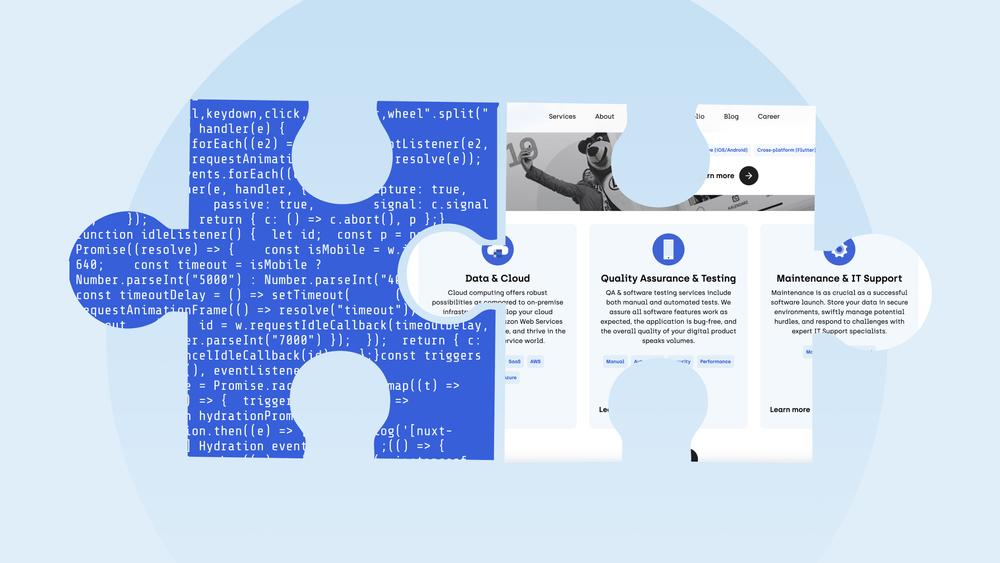
Remember when the big question in app development was native or cross-platform? Now there’s a new twist: what if we didn’t have to choose at all? In 2025, the line between cross-platform frameworks like Flutter or React Native and low-code platforms like OutSystems or Mendix is getting blurry. Companies are quietly mixing them — writing the core in code, while building side modules in visual editors. The result? Faster projects that still feel tailor-made. Welcome to hybrid development. Half code. Half no-code. 100 percent pragmatic.
Why the “either-or” days are over
The app market doesn’t wait. Budgets are smaller, timelines shorter, and every project seems to need ten integrations by default.
Cross-platform frameworks solved part of that puzzle: one codebase, many devices.
Low-code tools came next, helping teams build admin panels, prototypes, or internal apps with far less effort.
Now both worlds are colliding — and it makes sense.
- Cross-platform keeps performance high and design consistent.
- Low-code makes it easy to build, test, and adjust smaller elements.
Together, they create space for a new kind of workflow, where technical and non-technical people can finally work side by side.
What’s pushing the merge
1. Speed.
Every business wants to release faster. Low-code trims the design-to-test loop; cross-platform ensures the product scales later without a full rebuild.
2. People.
More teams outside IT are capable of building simple tools themselves. Developers no longer have to say “no” — they can say “start here, we’ll plug it in later.”
3. Architecture.
Modern products are modular by default. APIs, design tokens, shared libraries — they all make mixing technologies easier.
A feature can live in Flutter; a reporting module can sit in a low-code portal. The user won’t notice, and that’s the whole point.
4 .Maintenance pressure.
Updating one monolithic codebase every quarter doesn’t fit how companies work anymore. Splitting projects into manageable, partially automated pieces makes long-term maintenance realistic again.
What hybrid looks like in practice
Let’s take a familiar example.
A logistics company needs a customer-facing mobile app and an internal dashboard.
They build the app in Flutter — one codebase, native-like experience. They build the dashboard in a low-code environment — quick to launch, easy to tweak. Both talk to the same backend. Both share brand components.
The customer never knows one part was dragged into place and the other written line by line. That’s hybrid done right — thoughtful, efficient, invisible.
The benefits worth noting
1. Time
You can test ideas early and change direction without blowing the budget.
2. Cost
One team can cover more ground. Designers and analysts can build working prototypes instead of endless mock-ups.
3. Consistency
Shared APIs and design systems keep everything aligned, even when built in different tools.
4. Flexibility
Write code when you need full control. Skip it when a visual builder will do the job faster.
5. Delivery
Cross-platform already allows frequent releases; low-code reduces hand-offs and approvals. Together, they keep products moving.
The risks (and how to avoid them)
Governance.
When everyone can build, someone still has to check what gets shipped. Set clear review steps and version control rules from day one.
Integration.
Low-code platforms often come with their own data layers. Without planning, connecting them to your API stack becomes a puzzle.
Define a single integration standard and stick to it.
Technical debt.
Prototypes have a habit of becoming permanent. Mark which modules are short-term experiments and which need proper code later.
Performance limits.
Some hardware features — advanced sensors, animations, or offline modes — still perform best natively. Hybrid doesn’t replace expertise; it just prioritises it where it matters.
Why hybrid fits the moment
Every company building digital products faces the same balancing act: speed, cost, and control.
Hybrid development hits the middle ground.
Startups get to launch MVPs faster without blocking future growth. Enterprises let departments experiment without breaking compliance. Agencies can deliver both quick wins and long-term builds under one roof.
It’s not about being trendy. It’s about using the right amount of engineering for the right problem.
What’s next
Expect the boundaries to keep fading. Cross-platform frameworks are adding more visual tools. Low-code platforms are giving developers more access under the hood. And integration standards are improving so the two can finally coexist instead of compete.
Soon, calling a project “cross-platform” or “low-code” will sound a bit old-fashioned. It’ll just be “an app,” built the fastest, smartest way possible.
hero/dot’s take
At hero/dot, we see this shift every week.
Clients rarely ask for a specific framework — they ask for results: shorter build times, smoother releases, cleaner maintenance.
Sometimes that means full code.Sometimes a low-code module plugged into an existing system. Often, it’s a mix of both.
The method doesn’t matter as much as the mindset: build smart, not heavy.
Hybrid isn’t a compromise; it’s a reflection of how teams actually work today — cross-functional, time-pressed, focused on outcomes rather than tools.
Hybrid development is a reminder that there’s no single right way to build digital products.
The best approach is the one that keeps your roadmap flexible and your release calendar realistic.
If you’re planning a new product or modernising an old one, think hybrid first — and decide where code adds value, not just lines. That’s the future we’re already building at hero/dot.
Need expert assistance with your digital project?
Recent from Joachim Stelmach